Public Art Proposal Display

Art Proposals for Chinatown Public Health Center - Interior (English)

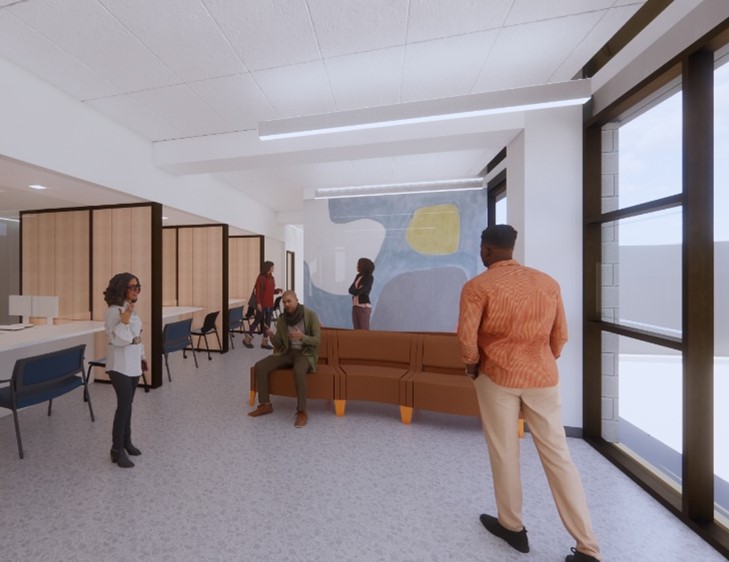
cphc interior.jpgThe San Francisco Arts Commission is conducting a review process to select artists to design artworks for three interior walls of the renovated Chinatown Public Health Center (CPHC). The artworks will be installed in the patient registration waiting areas on the first, second, and third floors of the clinic. Each artwork will measure approximately 100 square feet and be composed of digitally printed ceramic tile.

The goals of the project are to provide a welcoming, calming, and therapeutic atmosphere for CPHC clients and staff; reflect the culture, identity, and values of San Francisco’s Chinatown and its communities; and support wayfinding by helping clients easily locate patient registration areas.

Four artists have been selected as finalists by the Chinatown Public Health Center Artist Review Panel to develop conceptual design proposals for this opportunity: Monyee Chau, Mikael Gaspay, Vida Kuang, Amanda Phingbodhipakkiya.
 

華埠公共衛生中心:室內牆面藝術提案

Art Proposals for Chinatown Public Health Center - Exterior

Monyee Chau

Monyee Chau_CPHC_Board-smaller.pngInspirations for the artwork

Chinese folktales and mythologies have such a rich and vast depth, and provide context into the contemporary stories of today. In this illustration, I’ve incorporated many of the stories that inspired me as a child, and some that I came to learn about as an adult. Some I remember learning in Saturday Chinese School and grew up singing in the car, and others have been ones that I have used to help heal diasporic woes as I grow older.

As an adult, I’ve been interested in Daoist practices that are rooted in the universe’s harmony of Yin and Yang, leading me to east Asian astrology that embraces the animals as the ‘earthly branches’. One of the most influential practices has been engaging with the I-Ching, one of the oldest divination practices that was inspired by the cracks on the back of a tortoise shell found by Fuxi. These practices have all taught me how to strive for balance of harmony in my life. I found that these are all stories and mythologies that I wish I had more access to as a child, to help me shape the way I live my life. and that these larger-than-life stories can be translated into accessible art and illustrations.

My hope is that this painting can bring some of these joyous, larger-than-life stories into the realm of imagination for all those who get to experience it.

Description of the artwork

This illustration houses a plethora of folk tales, nursery rhymes, and mythologies. The imagery all surrounds the divine Fusang, the tree of life, often depicted as a mulberry tree. Sitting in the middle of the Fusang, is an observant samjoko, a powerful three legged crow who lives on one of the ten suns in Chinese lore.

There is the jade rabbit who is working on the elixir of immortality with a mortar and pestle. The mythological fox makes an appearance displaying the nine tails it’s grown over the many years, and the tortoise that carried the hexagrams of one of the oldest divinatory practices, the i-ching, on his back. There is a foo dog that comes to life, chasing a few butterflies from the nursery rhyme, Hu Die, and the fight between the snake and the crane which led to the creation of the theory of Yin and Yang, the origin story of practices such as Tai Chi. Every animal from the ‘Great Race’ of the Jade Emperor also makes an appearance to encompass the Lunar Zodiac, including the often excluded cat.

This artwork uses a color scheme of green, pink, yellow, orange, grey, and purple.

Context (Site, relationship to the project)

This work is an illustrated draft of the proposed mural for the Chinatown Public Health Center located in San Francisco. It is located as one of the interior walls for the waiting room on the 3rd floor, which houses the Chinatown Childhood Development Center.

The artwork is intended to have a soft color palette, one that is intentionally playful and fun; playful to young ones and enticing to young adults. Since this work is 10 feet tall, the artwork should not feel overbearing- but intentionally inviting in its imagination and storytelling. During my childhood, one of the ways I stayed connected to my roots was through the enormity of Chinese mythologies and folktales that inform so much of Chinese culture. I want this artwork to be an expansive reminder of the cultures and stories that Chinatowns often carry with them.

Method of materials used in site

The mural will be fabricated with printed tile, and the illustration will be painted with gouache to give a juxtaposing texture to the clean and smooth tile, as well as a gentleness with watery and feathered paint.

View a larger image.

Mikael Gaspay

Healing Ecologies

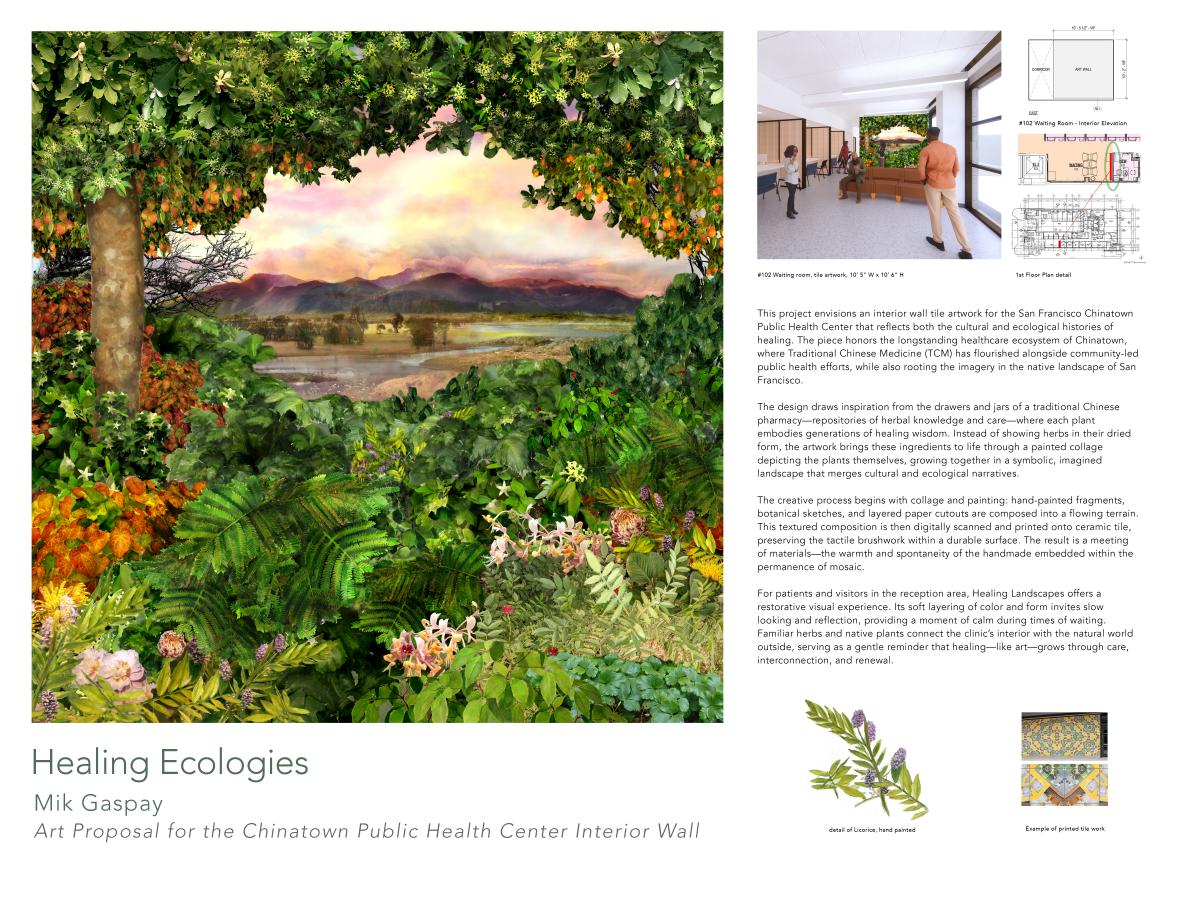
Mik Gaspay_proposal_concept_v4d.jpgThis project envisions an interior wall tile artwork for the San Francisco Chinatown Public Health Center that reflects both the cultural and ecological histories of healing. The artwork honors the longstanding healthcare ecosystem in San Francisco’s Chinatown, where Traditional Chinese Medicine (TCM) has flourished alongside community-led public health efforts, while also rooting the imagery in the native landscape of San Francisco.
The design concept draws inspiration from the drawers and jars of a traditional Chinese pharmacy—repositories of herbal knowledge and care—where each plant embodies generations of healing wisdom. Instead of showing herbs in their dried or prepared form, the artwork will bring these ingredients to life through a vibrant, painted collage depicting the plants themselves, growing together in a symbolic, imagined landscape.

The design process will begin with collage and painting, where hand-painted fragments, botanical sketches, and layered paper cutouts are composed into a single, flowing terrain. This painterly collage—intentionally imperfect and textured—will then be digitally scanned and printed onto ceramic tile, preserving the tactile quality of brushwork against the smooth, enduring surface of the tile. The result is a meeting of materials: the warmth and spontaneity of hand-painting embedded within the permanence of mosaic.

For patients and visitors waiting in the reception area, this artwork offers more than visual decoration—it provides a restorative visual experience. The soft layering of color and form invites slow looking, offering a moment of calm during what can often be a time of anxiety or anticipation. The rhythmic repetition of plants and the tactile, collage-like composition encourage a sense of connection and balance. Patients might find comfort in recognizing familiar herbs, or curiosity in discovering local plants they see in the city’s parks and hillsides—bridging the distance between the clinic’s interior and the living landscape outside.

By weaving together painting, collage, and tile, this artwork becomes a meditation on the act of healing itself—layered, adaptive, and rooted in both tradition and place. The mosaic serves as a gentle reminder that health, like art, grows through care, interconnection, and continual renewal.

View a larger image.

Vida Kuang

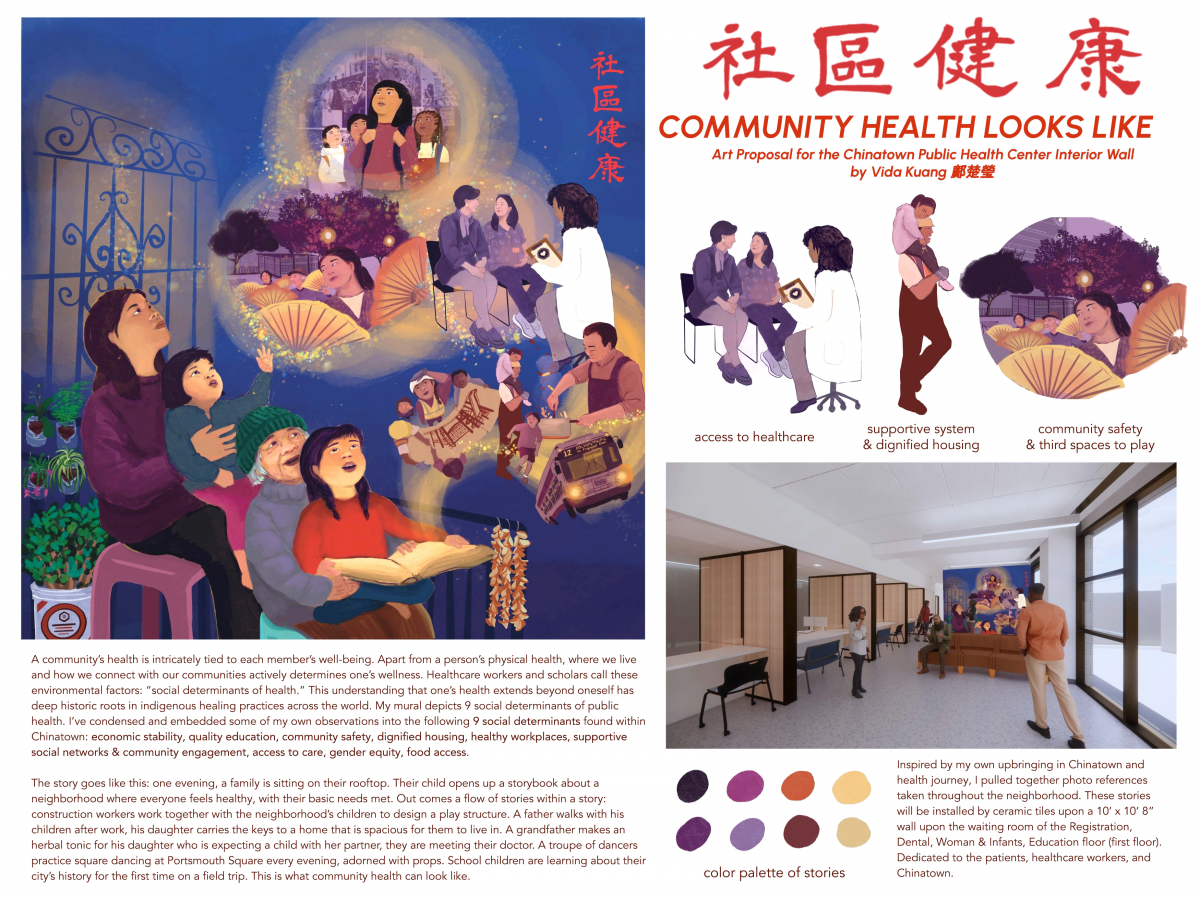
COMMUNITY HEALTH LOOKS LIKE 社區健康

Vida Kuang_Poster Board-1-smaller.pngINTRO

A few years ago, while working on a public art project, I came across a pattern of stories: generations of women living in SROs who have chronic physical and mental health challenges. This came out of a conversation I had with a daughter who witnessed not only her mother’s health decline, but also the women in her building. We spoke about the magnified stress from low income housing and the labor load women carry. My art practice has been an ongoing dive into the cross sections between health, labor, housing, class, and gender.

CONCEPT

Over the course of drafting this concept, it was important for me to make these vignettes relatable to people’s everyday experiences; moreover, show how an individual’s health and wellness is intricately tied to their larger community. The idea that one’s health extends beyond oneself has deep historic roots in indigenous healing practices across the world. My piece depicts 9 social determinants of public health. I’ve condensed and embedded some of my own observations into the following 9 social determinants found within Chinatown: economic stability, quality education, community safety, dignified housing, healthy workplaces, supportive social networks & community engagement, access to care, gender equity, food access. What will it look like for a community to have these needs met?

In the mural, the story goes like this: one evening, a family is sitting on their rooftop. Their child opens up a storybook about a neighborhood where everyone feels their best, physically, mentally, and in unity with their neighborhood. Out comes a flow of stories within a story: construction workers work together with the neighborhood’s children to design a play structure. A father walks with his children after work, his daughter carries the keys to a home that is spacious for them to live in. A grandfather makes an herbal tonic for his daughter who is expecting a child with her partner, they are meeting their doctor. A troupe of dancers practice square dancing at Portsmouth Square every evening, adorned with props. School children are learning about their city’s history for the first time on a field trip. They all show snapshots of what community health looks like today and the potential for everyone to have this.

VISUAL ELEMENTS

To create a balance in colors, I’ve limited my color palette for the vignettes. The outpour of stories create a flow that is tangible to the figures in the foreground. At the start of putting this narrative together, I wanted to incorporate elements of urban gardening, commonly found throughout the neighborhood. People upcycling containers for planters, growing plants or food wherever there is unoccupied space. The planters along the left are common houseplants residents of Chinatown have: the jade plant, asparagus fern, schlumbergera, spider plant, all of which tell a unique story of Chinese Americana & seed migration history. To the far right are chenpi drying along the railing, which reflects a strong tradition of dried food practices within the Cantonese diaspora. Juxtaposed within a sterile waiting room clinic, is a reminder that patients at the CPHC also carry with them their indigenous food and healing traditions.

Inspired by my own upbringing in Chinatown and health journey, I created each vignette based on photo references I’ve taken throughout the neighborhood. This piece is dedicated to the patients, healthcare workers, and Chinatown community. May we continue to heal each other.

View a larger image.

Amanda Phingbodhipakkiya

What We Carry 我們攜帶之物

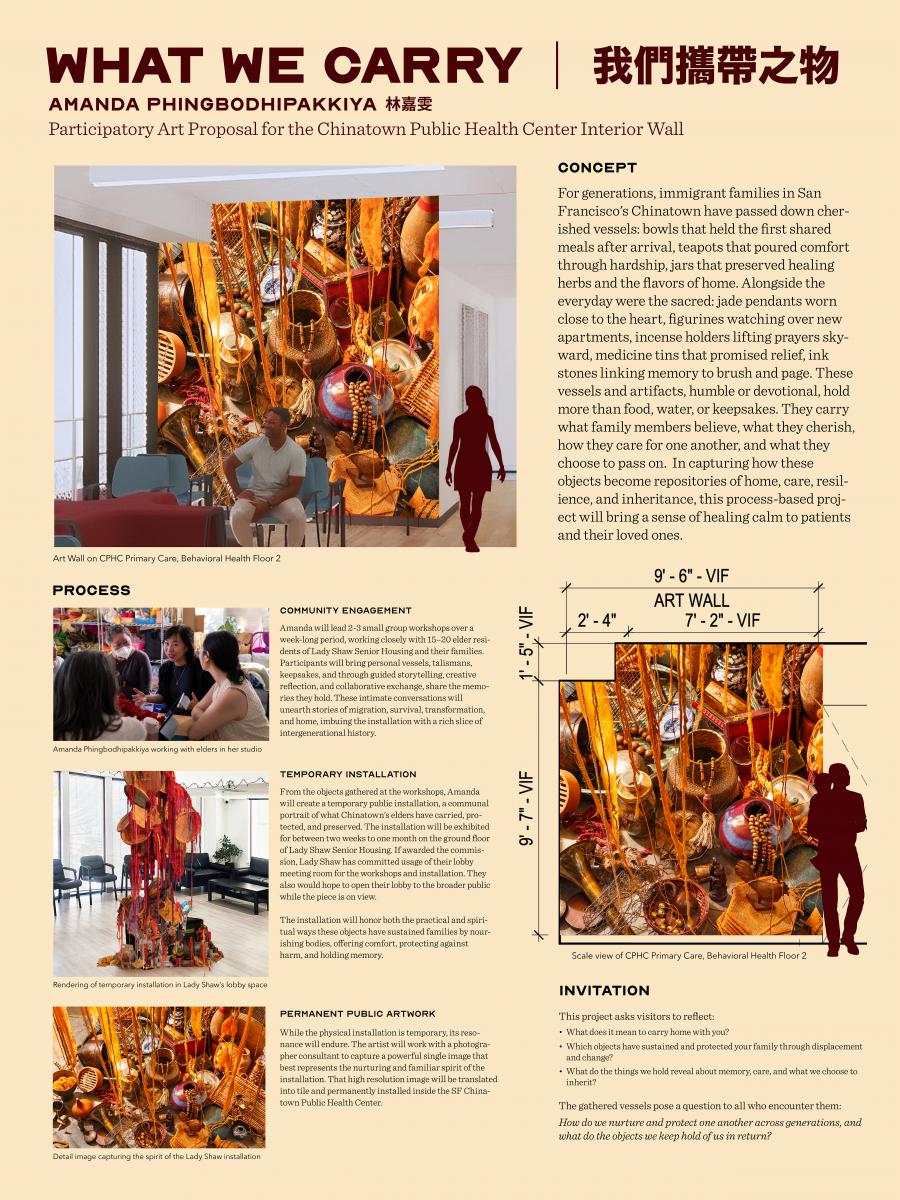
Amanda _Phingbodhipakkiya_What We Carry 我們攜帶之物 board.jpgWhat We Carry is a participatory public artwork rooted in Chinatown’s living memory. Over one week, Amanda Phingbodhipakkiya invites 15 to 20 elder residents of Lady Shaw Senior Housing and their families to bring vessels and talismans from home. In small group workshops, participants share how bowls, teapots, jars, jade pendants, figurines, incense holders, photographs, medicine tins, and ink stones anchored first meals, protection, healing, and belonging. Guided storytelling, creative reflection, and collaborative exchange surface intergenerational histories of migration, survival, and care.

From these objects and narratives, Amanda assembles a temporary installation on the ground floor of Lady Shaw, on view for two weeks to one month. The display forms a communal portrait of what Chinatown’s elders have carried and preserved. Each vessel will serve as a symbol of a family’s presence in this neighborhood, an imprint of memory, survival, and love. After the viewing period, all items are returned to their owners.

The project’s lasting presence will be a single large image, created with a consulting photographer, that captures the installation’s nurturing spirit. That high resolution photograph will be translated into tile and permanently installed inside the SF Chinatown Public Health Center, a neighborhood clinic serving the community since 1929. The work is intended to offer familiar, nourishing, calm imagery to patients and families during times of stress, linking care, health, and belonging.

Viewers are invited to consider: What does it mean to carry home with you? Which objects have sustained and protected your family through displacement and change? What do the things we hold reveal about memory, care, and inheritance?

Personal connection: As a Brooklyn-based Thai and Chinese-Indonesian artist, my work spans participatory installations, textiles, sculpture, murals, and public art rooted in belonging and repair. In the Bay Area, I partnered with the Asian Women’s Shelter and BART on Let’s Talk About Us, a domestic violence prevention campaign that wove art and resources into the transit system. As a Civic Practice Artist in Residence with the Asian Art Museum, I have collaborated closely with Chinatown community members and students. Across projects—from I Still Believe in Our City, which rebuked anti-Asian hate, to community-based commissions nationwide—I use art to honor resilience, invite reflection, and create spaces of care.

View a larger image.

Opportunity For Public Comment

Please take a few minutes to review these artwork proposals and provide feedback. The proposals are available online at www.sfartscommission.org/calendar/proposal-displays, or accessed by the QR Code below, where you can leave feedback in the public comment form. Comments may also be submitted via email to sfacpublicartcomment@sfgov.org by Monday, December 22 at 5:00 p.m. PST.

Public comments will be considered by the Review Panel as part of the Final Review Panel meeting where the Panel will recommend one proposal for implementation. Please note that public comments do not constitute a vote.

The Final Review Panel meeting will take place remotely the week of January 12, 2026. All Artist Review Panel meetings are open to the public. An agenda for the meeting will be posted 72 hours in advance of the meeting on SFAC’s website under the Public Meeting section: www.sfartscommission.org

For more information, please contact: sfacpublicartcomment@sfgov.org, or (415) 252-2100. Materiales traducidos están disponibles para usted de manera gratuita. Para asistencia, notifique a sfacpublicartcomment@sfgov.org, or (415) 252-2100.  我們將為閣下提供免費的書面翻譯資料。 如需協助,sfacpublicartcomment@sfgov.org, or (415) 252-2100. Ang mga materyales na nakasalin sa ibang wika at ang mga serbisyong tagapagsalin sa wika ay walang bayad. Para sa tulong, maaring i-contact si sfacpublicartcomment@sfgov.org, or (415) 252-2100.

What's Coming Up

Public Meeting

Advisory Committee of Street Artists and Crafts Examiners

October 07
/
10:30 AM to 12:00 PM

Hybrid: 401 Van Ness | Rm 125 and Online
Public Meeting

Advisory Committee of Street Artists and Crafts Examiners

July 01
/
10:30 AM to 12:00 PM

Hybrid: 401 Van Ness | Rm 125 and Online
Public Meeting

Advisory Committee of Street Artists and Crafts Examiners

May 06
/
10:30 AM to 12:00 PM

Hybrid: 401 Van Ness | Rm 125 and Online
Public Meeting

Advisory Committee of Street Artists and Crafts Examiners

January 07
/
10:30 AM to 12:00 PM

Hybrid: 401 Van Ness | Rm 125 and Online